

NGL stands for “not gonna lie”. The NGL meaning in a text is close to “honestly”: it marks the words around it as a candid admission or an opinion the sender suspects you won’t love. Most of the time it softens the message. It can’t make a harsh line kind, though. NGL is also the name of an anonymous Q&A app, covered further down.
We checked Cambridge Dictionary, Wiktionary and the US Federal Trade Commission’s records on the NGL app on 23 October 2026.
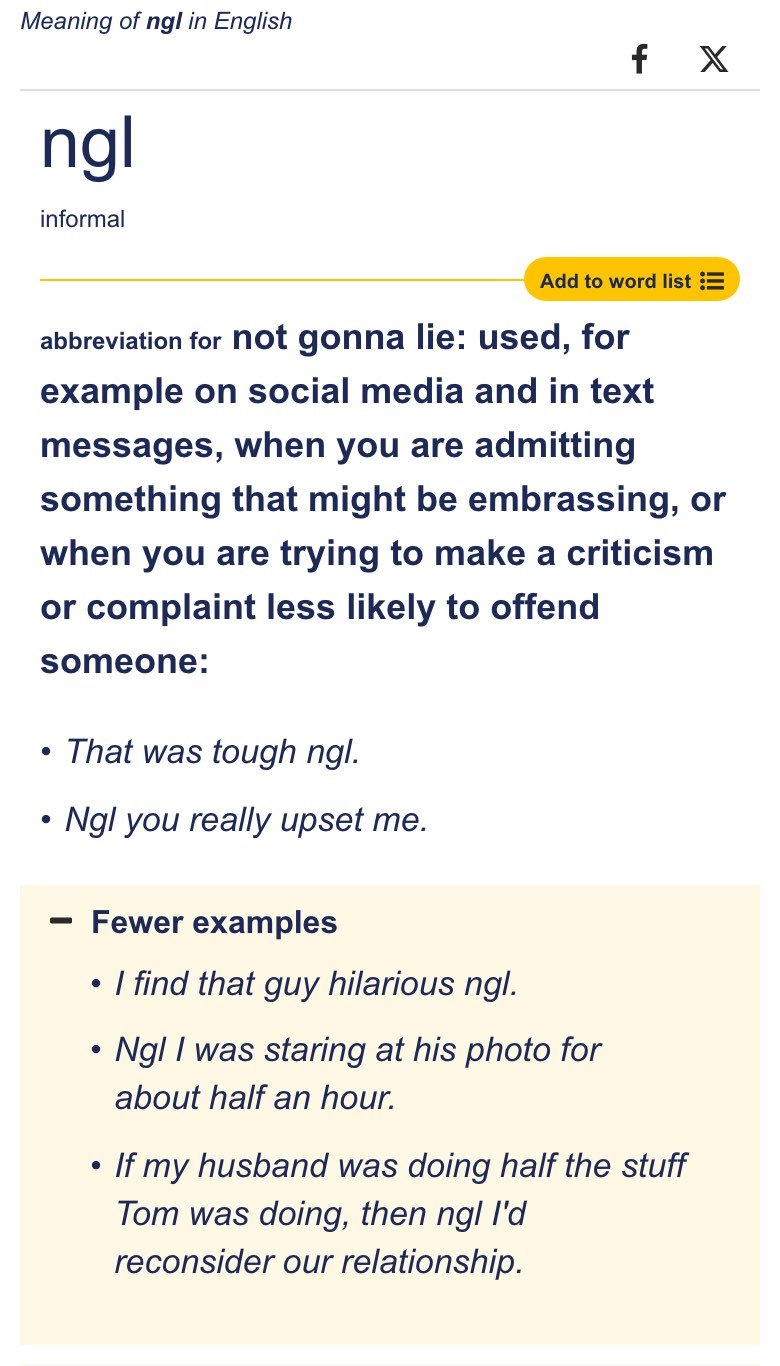
Cambridge Dictionary's ngl entry, from the Internet Archive's copy of 23 October 2026 (Cambridge blocks automated browsers), captured the same day. One definition, two jobs: owning up, and taking the sting out of a complaint.
What does NGL mean in slang?
In slang, NGL means “not gonna lie”, a casual way to say “honestly” before or after a frank remark. Cambridge Dictionary labels it informal and says it’s used “on social media and in text messages”. Wiktionary files it under internet and text-messaging slang as “(I’m) not gonna lie: to tell the truth”.
Quick answer
| Question | Answer |
|---|---|
| What does NGL stand for? | Not gonna lie, sometimes “I’m not gonna lie” |
| What does it mean? | Honestly. An admission or a frank opinion is coming, or just came |
| Is it rude? | Not on its own. It usually softens. The words around it set the tone |
| Capitals or not? | Same meaning. Cambridge heads its entry “ngl”, Wiktionary “NGL” |
| Close relatives | tbh, icl, fr |
| Also | NGL, an anonymous Q&A app named after the phrase |
Owning up or softening the blow: the two jobs of ngl
Cambridge’s definition gives ngl two jobs.
1. Owning up. The sender admits something small and slightly embarrassing about themselves.
“ngl I’ve rewatched that trailer about nine times”
2. Softening an opinion. Cambridge describes this as “trying to make a criticism or complaint less likely to offend someone”. The ngl warns that a frank take is coming, so it lands more gently.
“the new menu is a bit much ngl”
When ngl softens and when it sounds blunt
Ngl changes how a message is framed, not what it says, so a harsh verdict stays harsh. Treat it as a cushion, not a pardon.
| Message you get | How it lands | Why |
|---|---|---|
| “ngl I was nervous before your call” | Warm, a bit vulnerable | It’s about the sender, not you |
| “ngl the second half dragged” | Mild and honest | Criticism of a film, not a person |
| “ngl you could’ve told me sooner” | A gentle complaint | Softened, but still a complaint |
| “ngl your plan won’t work” | Blunt | A flat verdict. The ngl barely cushions it |
| “this is mid ngl” under a stranger’s post | A jab | Public, unasked for, aimed at someone’s work |
These messages are made up to show the pattern.
What tips it: who the opinion is about (yourself is safest), whether anyone asked, and how hard the words after ngl hit. To keep yours soft, aim it at the thing, not the person.
Where does ngl go in a sentence?
Ngl can open a sentence, close it or sit in the middle, and Cambridge’s own examples use all three.
- At the start, it’s a warning. “Ngl you really upset me.” The reader braces for honesty before it arrives.
- At the end, it’s an afterthought. “That was tough ngl.” and “I find that guy hilarious ngl.” The opinion comes first and ngl owns it, which often reads lighter.
- In the middle, it marks where the honest part begins. “If my husband was doing half the stuff Tom was doing, then ngl I’d reconsider our relationship.” Everything after it is the candid bit.
A comma after ngl is optional; none of Cambridge’s examples use one.
How to reply to ngl
Reply to the honest part, not the three letters. If the criticism is about you, the ngl usually means they tried to be kind, so answer in kind.
| They send | What it’s doing | A reply that works |
|---|---|---|
| “ngl I’ve missed our walks” | An admission | “same. saturday morning?” |
| “ngl the ending lost me” | A mild opinion | “fair, the last ten minutes were a lot” |
| “ngl that comment hurt a bit” | A soft complaint about you | “sorry, I didn’t mean it like that. can we talk?” |
| “ngl you’re kind of funny” | A compliment, framed as a confession | “kind of?? I’ll take it” |
| “ngl I don’t think I can make it” | An honest no | “no worries, thanks for telling me straight” |
You don’t need to send an ngl back, though an icl (“icl I liked it”) matches their honesty. A flatter refusal may skip ngl altogether and arrive as an hn.
NGL vs tbh, icl and lwk
All of these flag a frank remark, each with its own flavour:
| Term | Stands for | How it differs from ngl |
|---|---|---|
| tbh | To be honest | Very close to ngl. Wiktionary’s NGL entry points to it under “See also” |
| icl | I can’t lie | Same job, with a UK origin and a slightly more dramatic feel |
| lwk | Low-key | Softens by playing a feeling down, rather than by flagging honesty |
| fr | For real | Confirms something is true, often after the fact |
NGL, the anonymous Q&A app
The NGL app is named after the phrase. The FTC’s business guidance blog says the app “is named for the text shorthand for ‘Not Gonna Lie’”. Users share a link on social media, and anyone who taps it can send them a message without giving a name. Its App Store listing, “NGL: ask me anything”, sums it up as “Share your NGL Link” and “Friends answer right on your story”.
In July 2024 the FTC and the Los Angeles District Attorney’s Office took action against the company, alleging it marketed the app to children and teens, falsely claimed its AI moderation filtered out cyberbullying, and sent fake messages to sell its paid tier.
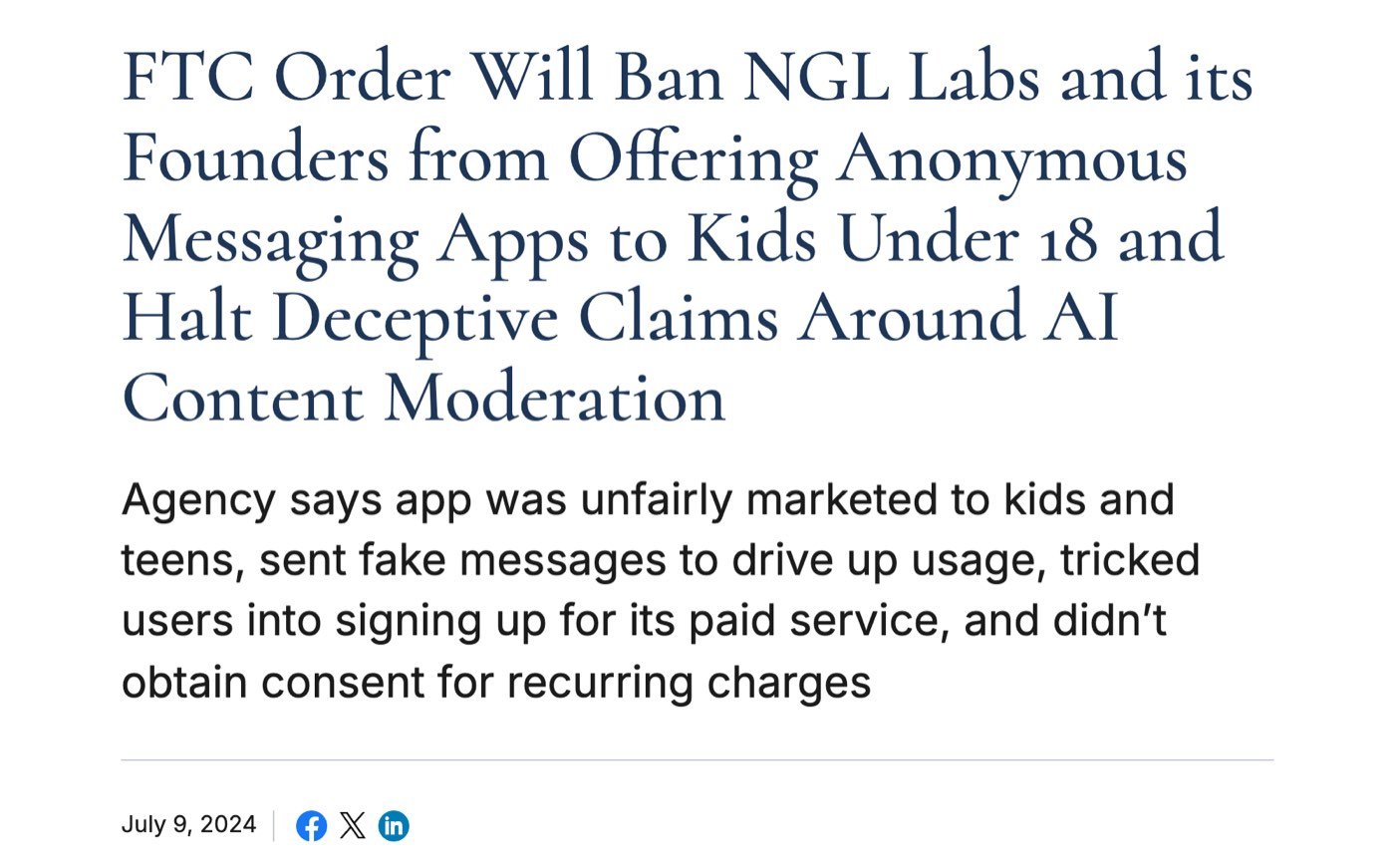
The FTC's press release of 9 July 2024, from the Internet Archive's copy of 28 September 2026, captured 23 October 2026. We read the live page that day; its text matched.
What the FTC’s records say:
| What happened | |
|---|---|
| The order | NGL can’t offer the app to anyone under 18, and must put a neutral age gate in front of it |
| The money | $5 million: $4.5 million for refunds and a $500,000 civil penalty to the Los Angeles DA’s office |
| Fake messages | The FTC says that from 2022 NGL sent “fake computer-generated messages that appeared to be from real people” |
| The paid tier | NGL Pro cost “as much as $9.99 a week” and gave “hints”, not a sender’s name, the complaint says |
| Refunds | Claims were open until 6 April 2026 for people who paid for NGL Pro between January 2022 and July 2024 and had unauthorised charges (FTC) |
| Today | The US App Store lists the app as 18+, and describes NGL Pro as giving “Hints about who sent each of their messages” |
If a teenager mentions NGL, ask which one: the phrase is harmless, the app is rated 18+. Our guide to teen texting abbreviations covers the rest.
What we checked
On 23 October 2026 we read:
- Cambridge Dictionary’s ngl entry. The live page blocks automated browsers, so we had the Internet Archive save it and screenshotted that copy, hiding a sticky menu bar that covered the examples. The entry itself is unchanged.
- Wiktionary’s NGL entry, last edited 14 October 2026.
- The FTC’s press release of 9 July 2024 (screenshot from the Internet Archive’s copy of 28 September 2026), its blog post of the same day and its refund notice of 6 January 2026.
- The US App Store listing for its age rating and description. We didn’t install the app.
- Pew Research Center’s definition of the generations.
- Urban Dictionary’s NGL entries, which are user-written, so evidence of usage only. The oldest is dated 1 January 2009.
Questions people ask
What does NGL mean in slang?
“Not gonna lie.” It works like “honestly”, flagging an admission or a frank opinion. Cambridge Dictionary labels it informal.
Is NGL Gen Z slang?
Not only. Urban Dictionary’s user-written NGL entries go back to 2009, when the oldest members of Gen Z (born from 1997 on, by Pew Research Center’s definition) were about 12. Cambridge labels it simply informal, with no age attached.
What does NGL mean from a girl?
The same as from anyone: “not gonna lie”. There’s no separate meaning by gender. In a flirty chat, “ngl you’re kind of cute” frames a compliment as a confession, a low-pressure way to say it. Read it as interest, said gently.
What is an example of NGL?
“That was tough ngl” is one of Cambridge’s own. Two more: “ngl I still can’t parallel park” (owning up) and “that café is overrated ngl” (a softened opinion).
The short version
NGL means “not gonna lie”. It flags an admission or softens an opinion, at the start, end or middle of a sentence. It cushions criticism without cancelling it, so reply to what was said. And an NGL link in a Story is the anonymous Q&A app, which a July 2024 FTC settlement bars from serving anyone under 18.
For more shorthand that flags an opinion, see our list of text abbreviations, or learn how to decode slang you’ve never seen.